


 Ingresar


Brazil takes steps yo expand international legal cooperation
By Volkhart Hanewald
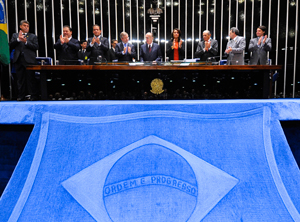
The first decree (no. 500) created a study group initially composed of members of the Ministries of Justice and Foreign Affairs. However, members of other public entities as well as academic and civilian organizations may be invited to join. This study group has been tasked with preparing the ratification of the 2007 Hague Convention on the International Recovery of Child Support and Other Forms of Family Maintenance and the Protocol on the Law Applicable to Maintenance Obligations.
The second decree (no. 501) covers the treatment of requests of assistance from foreign courts that do not require deliberations by the Brazilian Federal Supreme Court (STF). Although these requests are thus limited to assistance in serving writs to persons residing or doing business in Brazil, the decree may be considered a giant step forward as now rules of procedure and formal requirements have been established for the treatment of these requests.
These two decrees should be seen as steps in the right direction. For a long time Brazil has neglected development of its legislation and doctrine in the fields of private international law and private international civil procedure.
However, much more work must be done. The principal code dealing with matters of private international law is still the Introductory Law to the Civil Code from the year 1942, which consists of only 19 sections. (The equivalent German Introductory Law, for example, has 248 sections). Also, Brazil should make an effort to ratify the Hague Apostille Convention. Private international law should be considered (and taught in law schools) as a part of civil law, not as part of public international law, as is currently the case. Finally, the legislation concerning the validation and execution of foreign judicial decisions should be overhauled, removing the exclusive competence away from the (already overcharged) Superior Court of Justice and giving it to the magistrate of first instance in the district where the actual execution is to take place.
In this manner, Brazil will ensure that it is not left behind in the globalization phenomenon currently being witnessed.
Dannemann Siemsen

Recognised as leaders in Intellectual Property in Latin America, we are a team of experts who has been dedicated to defending industrial and intellectual property since 1900. We operate throughout the world, encompassing first-rate civil and criminal advocacy, covering diverse areas of Law and all segments of industry. We are partners of large national and international companies.
Today we have offices in three Brazilian state capitals and we have gathered a team of practitioners that lead in knowledge of intellectual property, litigation, contracts and other areas of Law.
This allows us to advise our clients in the main legal proceedings, making us a strategic partner in the pursuit of innovation and knowledge.
We have more than 280 lawyers and an extensive team of Industrial Property Agents – an experienced and specialised technical team that is kept up-to-date with the transformations and demands of the market.
We are the support for innovation and knowledge.
We live in a dynamic world, where knowledge is decisive for any company to stand out in the market. We believe in the value of human capital and in creativity as a source of innovation.
With more than a century of experience and a wide range of services, we are proud to be the foundation for our clients to seek innovative and disruptive paths.
