


 Ingresar


Challenges and Opportunities in Managing Sports Institutions and Professional Associations
By BKM | Berkemeyer
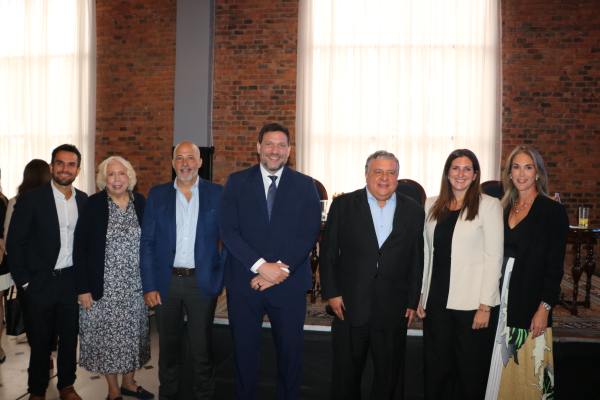
BKM | Berkemeyer hosted a working breakfast on June 6, 2025, in Asunción titled “Challenges and Opportunities in the Management of Sports Institutions and Professional Associations.” The event took place at Hotel Nino and brought together law firms, attorneys, and intellectual property professionals from across Paraguay.
The keynote speakers were Matías Noetinger (Noetinger & Armando, Argentina) and Monserrat Jiménez (Deputy Secretary General and Legal Director of CONMEBOL), with Wilfrido Fernández (Managing Partner at Zacarías & Fernández Abogados) serving as moderator.
Antonio Villa Berkemeyer opened the event, emphasizing the attendance of more than 60 participants on-site, along with many others following via livestream. Among the attendees were Pamela Cristaldo and Diego Pérez, respectively Director of Industrial Property and Director General of Enforcement at Paraguay’s National Intellectual Property Directorate (DINAPI), and Raquel Toñanez, a member of the Executive Committee of the Inter-American Association of Intellectual Property (ASIPI).
"In light of the ASIPI seminar to be held in Asunción in mid-2026, this is a good time for us in Paraguay to begin organizing as a group," said Villa. Remarks were also given by Juan Ortiz, Paraguay’s national delegate to ASIPI, and Fabrizio Modica, President of the Paraguayan Association of Intellectual Property Agents (APAPI).
CONMEBOL's Challenges
In introducing the speakers, Wilfrido Fernández described the topic of the breakfast as “very interesting and comprehensive,” noting its focus on the many intersections between law and sports. “We’d need a whole month to address topics of this magnitude,” added Monserrat Jiménez.
In her presentation, the Paraguayan attorney outlined her work at the South American Football Confederation (CONMEBOL) and Paraguay’s key role within the organization, which is headquartered in Luque, led by a Paraguayan president (Alejandro Domínguez), and staffed predominantly by Paraguayan professionals.
She then discussed CONMEBOL’s revenue model, noting that its most valuable assets are its trademarks. “To generate revenue, we essentially sell commercial rights: broadcasting rights, sponsorship rights, and merchandising rights,” she explained. “Broadcasting rights include free-to-air television, cable, and the full range of digital and streaming platforms. Around 85% of our income comes from the sale of these rights, primarily in Brazil and other South American markets, although we sell globally,” she added.
With respect to sponsorship rights, she mentioned these are traditionally tied to advertising boards in stadiums and more recently, to companies offering branded experiences for fans.
Regarding merchandising, Jiménez acknowledged that it poses the greatest challenge for CONMEBOL due to lower market value in South America compared to Europe. “The cost of enforcing those rights—such as combating unauthorized reproduction of trademarks—does not correspond to the commercial value merchandising currently holds for CONMEBOL.”
She explained that CONMEBOL holds the rights to 33 competitions, but only three generate significant revenue: the Copa América (national teams), the Copa Libertadores (clubs), and “sometimes” the Copa Sudamericana. She also identified eSports and digital platforms as the "rising stars" among competitions: “I believe the greatest number of legal disputes over the next five years will arise in this space, especially regarding who owns the rights with video game publishers,” she predicted.
Jiménez also addressed footballers’ rights, classifying them into three categories:
-
Match Participation Rights – Arena rights derived directly from playing the sport, usually regulated by collective bargaining agreements between unions and leagues or federations.
-
Image Rights – The commercial use of a player’s image, including their name, likeness, persona, and reputation, typically negotiated individually with clubs.
-
Commercial Licensing Rights – Image rights granted for use outside the club, usually licensed to companies or third-party sponsors.
She noted the growing importance of a fourth category: personal data. “There’s currently a major international dispute: Who owns this data? Who has the rights? How is it acquired? Its commercial value is increasingly significant. FIFA has begun to regulate the matter, but the players’ union, FIFPro, insists that these data categories belong to the players,” she said.
She broke down this data into three types:
-
Non-intrusive performance data, collected through broadcast technology (e.g., distance covered, positional tracking), which holds high value for betting companies.
-
Basic biometric data, such as heart rate, exertion, and acceleration, gathered via wearable chips embedded in vests under players’ jerseys, managed and owned by the clubs.
-
Highly sensitive personal data, gathered during training, matches, and medical evaluations—including heart performance, blood oxygen levels, and medical history—which are typically managed by clubs but legally considered the players' property due to their sensitive nature.
Matías Noetinger’s Perspective
With a long-standing career in intellectual property, Matías Noetinger shared his experiences working on sports-related cases. “It’s always fascinating to work with sports brands and handle infringement and counterfeit matters,” he noted.
Noetinger has also worked on sports law issues beyond IP and offered practical advice to fellow IP attorneys interested in entering the field: “Sports law has its own set of complexities, practices, and customs that require a steep learning curve. You often have to learn by trial and error,” he said. “You approach the field enthusiastically, but it’s complex. The world of sports—particularly football—is filled with intricacies and demands full-time dedication. It’s often difficult to manage alongside IP as a secondary practice,” he added.
He shared several experiences, including representing a player agent in litigation to recover economic rights from the domestic and international transfers of a footballer (from Argentina to Switzerland, and then to Germany).
He also collaborated with renowned Italian publisher Panini to secure the necessary permissions to use the images of Argentine footballers in a domestic sticker album.
In Argentina, he explained, a collective licensing model is in place: the players’ union grants Panini the image rights for all players, while the Argentine Football Association (AFA) authorizes the use of club identifiers (names, crests, jerseys, etc.). In other jurisdictions, such rights are usually negotiated individually by clubs and players. In Argentina, however, Panini continues to work under this collective system, supported by a court ruling dismissing a claim by Boca Juniors, which had argued it had never individually licensed image rights to the company.
“These kinds of cases show the perfect convergence of sports and IP and the legal conflicts that arise from it,” said Noetinger, referencing another case involving Boca Juniors. The club—one of the two most popular in Argentina alongside River Plate—was granted well-known trademark status for its unique blue and yellow color combination used in its jerseys.
“That particular color combination was granted well-known trademark status. Legally and commercially, it was a landmark decision for Boca. The judge, in a rather colorful ruling, wrote: ‘Even my aunt, who doesn’t watch football, knows that this color combination belongs to Boca Juniors.’ That decision gave Boca the legal foundation to begin widespread enforcement of its trademarks and identifiers, leading to a series of lawsuits to protect products like towels and bedsheets that used the same colors,” he explained.
As First Vice President of ASIPI, Noetinger closed the event by extending an invitation to the 2026 ASIPI seminar in Asunción. “Next year’s mid-year seminar will take place right here in Asunción, and the theme will be Intellectual Property and Sports. Of course, we’ll invite Monserrat to join us. We’ll feature around eight panels to delve deeper into the topics we discussed today—broadcasting rights, ambush marketing, the growing relevance of amateurism, the commercial value of amateur athletes, and the intersection of data and technology. These will be led by international experts, and everyone here is warmly invited. We look forward to welcoming you.”
BKM | Berkemeyer

Established in 1951, BKM | Berkemeyer provides expert legal services to local and foreign clients in Paraguay, gaining a global reputation for quality, expertise and professionalism.
BKM | Berkemeyer prides itself on the ability to meet clients’ needs directly, providing professional and practical advice of the highest quality through team-work and collaboration to render services in a thorough manner.
Lawyers in the firm are multilingual, speaking Spanish, English, German, French, Portuguese, Italian and Japanese, which facilitates efficient and expeditious communication.
