


 Ingresar


Crossing the Panama Canal Now Costs Over a Million Dollars
By De Puy & Asociados
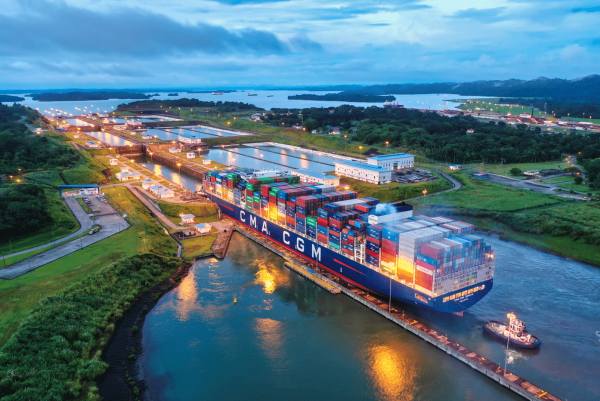
The Panama Canal handles approximately five percent of global maritime trade and serves as the primary corridor connecting the U.S. East Coast with the markets of East Asia. Like any chokepoint infrastructure, its value to shipping operators rises sharply when alternative routes are compromised. When access to the Strait of Hormuz — through which roughly one-fifth of the world's oil and natural gas exports from Gulf producers normally flows — is disrupted by military conflict or sanctions enforcement, operators must reassess their logistical options, often at significant cost and under time pressure.
That pressure has a measurable market expression. The Panama Canal Authority operates a last-minute priority booking auction, through which vessels without advance reservations can purchase an expedited transit slot. Under normal market conditions, bids in these auctions have averaged around USD 130,000 per vessel. When Hormuz access is restricted and Asian buyers pivot to U.S. energy sources routed through the Pacific, demand for Canal priority slots rises considerably — and with it, auction prices. Recent figures from the Authority place the average at approximately USD 385,000, with individual bids for liquefied natural gas carriers reaching $4 million in at least one documented case.
Charter parties, sale and purchase contracts, and downstream supply agreements routinely allocate transit costs and schedule risk between counterparties. When an operator faces a choice between a multi-million-dollar auction bid and a five-day delay, the relevant question is often not simply commercial — it is contractual. Which party bears the cost of the delay? Does the charter contain a demurrage clause that makes delay more expensive than the auction price? Does the cargo contract impose penalty clauses for late delivery that shift the calculus toward paying?
Force majeure clauses are equally relevant. Where a party seeks to excuse non-performance on the grounds that a primary route — such as the Strait of Hormuz — has been rendered impassable by conflict, the availability of an alternative route through the Panama Canal may bear directly on whether the force majeure threshold is met. The existence of a functioning alternative, however costly, tends to weigh against a successful force majeure invocation under most common law and civil law frameworks.
Canal traffic data provides useful context for assessing the durability of these dynamics. The Authority reported an average of 34 vessel transits per day in January, rising to 37 in March and exceeding 40 on peak days — figures consistent with a structural, rather than episodic, rerouting of energy cargo. In the first half of fiscal year 2026, the canal recorded 6,288 transits, a year-on-year increase of 3.7 percent. The Authority has attributed the growth to shifts in global trade patterns driven by geopolitical conditions affecting key alternative routes.
The broader lesson for transactional and disputes practitioners is that geopolitical risk translates into concrete cost and schedule variables with direct relevance to contract performance. Auction prices at the Panama Canal are, in this sense, not merely a curiosity of maritime logistics — they are a proxy for the cost of disruption, and a useful input when advising clients on risk allocation in cross-border energy and commodity transactions.
De Puy & Asociados

De Puy & Asociados is a boutique law firm proud to deliver personalized, efficient service provided by top-tier attorneys to each of our valued clients.
Based in the Republic of Panama, our experienced legal team specializes in intellectual property and offshore corporate matters in both Panama and Belize. Over the years, De Puy & Asociados has achieved remarkable growth in the Criminal Misuse practice area, securing favorable and high-profile outcomes for our clients.
We also offer in-depth expertise in immigration and real estate transactions, providing comprehensive legal support to investors and families seeking to establish a presence in Panama.
