


 Ingresar


Foreign investment promotion in the natural gas industry
By PPO Abogados
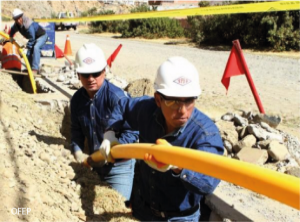
The hydrocarbons law (Law 3058, May 2005), imposed a tax increase on oil companies and expanded the presence of the State in the hydrocarbon production chain. Bolivia possesses approximately 12.5 trillion cubic feet (TCF) of natural gas reserves (both proven and probable). Of this amount, 10.7 TCF are proven reserves. The state hydrocarbons company, Yacimientos Petroliferos Fiscales Bolivianos (YPFB), generally forms joint ventures (55-45 percent sharing, with the state owning the majority share) for a limited period of 40 years with private companies for extraction services. The hydrocarbons law and a subsequent Supreme Decree (May 2006) require that companies sell all production to YPFB and that domestic market demand be met before exporting hydrocarbons.
Furthermore, these laws transfer the entire transport and sales chain over to state control. After the law was enacted, hydrocarbon companies were required to sign new contracts with YPFB, agreeing to pay 50 percent of gross production in taxes and royalties.
After an initial growth, natural gas production has declined during recent years and investment in exploration activities are also in decline.
"We do not have an increase in gas reserves, which leads us to rethink the entire regulatory framework", Molina stated before Senate, where a bill was approved to modify the oil services contract for the exploration and exploitation of natural gas in the Charagua area, located in the department of Santa Cruz and with an estimated potential of 2.1 trillion cubic feet (TCF) of natural gas.
PPO Indacochea

PPO Indacochea is Bolivia’s leading full-service law firm, formed through the strategic merger of PPO Abogados and Indacochea & Asociados—two of the most prominent and respected legal institutions in the country. With the largest team of lawyers and the broadest geographic coverage in the market, we are uniquely positioned to deliver legal solutions that are innovative, multidisciplinary, and business-oriented.
Our approach is simple and effective: we provide solutions, not just opinions. We work closely with our clients to understand their businesses and deliver strategic advice tailored to their most complex challenges. We channel transformative foreign investment into Bolivia, advise on high-stakes disputes before local and international tribunals, and offer end-to-end legal services that bridge the gap between law and business.
With a team of 85 lawyers and over 180 professionals led by 14 partners, we operate across six offices in five cities nationwide. Our professionals include top-tier talent—most trained or specialized abroad—with a strong commitment to diversity, inclusion, and social responsibility.
At PPO Indacochea we redefine legal services to anticipate and exceed the demands of a fast-evolving business environment. We are proud to be consistently recognized by the most prestigious international legal directories, including Chambers and Partners, Legal 500, IFLR1000, Leaders League, Latin Lawyer, LACCA, and others, as Bolivia’s leading law firm. PPO Indacochea: Where law meets strategy, and local depth meets global vision.
