


 Ingresar
 Compartir:


Paraguay considering legislative ammendments to existing legislation on seeds and plant breeders rights
By Cristobal Gonzalez, Berkemeyer Attorneys & Counselors
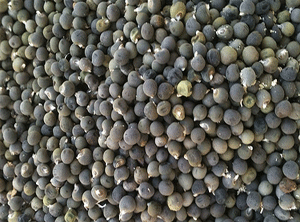
The above mentioned legislation contains several rules similar to other countries in the region. It contains some well written articles and others which could cause confusion in several respects and are not suited to current practice and international standards governing the matter.
The main points to take into are the following:
1. Enforcement authority and organization - The proposed bill suggest that the Paraguayan Office of Quality and Plant Health and Seeds, once in force should issue an enforcing body. The Seeds Directorate currently is the technical enforcement agency of the law, with their respective units. The entity is recognized for its technical ability, despite the fact that it has not been flawless over the years. The Seed Directorate should remain unchanged under the supervision of the authority of SENAVE.
2. National seed system:-Article 6 et seq. - The national seed system proposed in the draft legislation is based on the Brazilian law, but the project is a mixture of logging and trade of seeds with plant breeders' rights which would create an overlay of records. In the Paraguayan Seed Law 385 the differentiation is specified, exists between the two records. These provisions should be maintained and enhanced, to avoid overlay records and functions.
3. Technical Evaluation Committee – Varieties (art. 21) - The current provisions law 385, establishes that the Technical Committee of qualification should consist of people from the public and private sectors. This committee has shown great professionalism, speed and expertise in evaluation, so its integration should be maintained and not change. The draft bill suggests a new committee which will consist only of officials appointed by SENAVE, this is a mistake.
4. UPOV91 - The draft bill does not meet the minimum standards of UPOV91. The draft bill contemplates and maintains the same rights established by Paraguayan Law 385/94, thus to modify the law in these conditions would make no sense. Likewise, the suggested modifications would not improve the current conditions of seed producers and breeders.
5. USE. Articles 51 and 52 - The proposed articles on the draft bill are identical to the current law 385, which has already caused great harm to most seed producers and breeders. Considering that use has been controversial and allowed large producers use this exception to purchase non- certified seed. In conclusion modifying the current legislation without changing this article makes would be irrelevant.
BKM | Berkemeyer

Established in 1951, BKM | Berkemeyer provides expert legal services to local and foreign clients in Paraguay, gaining a global reputation for quality, expertise and professionalism.
BKM | Berkemeyer prides itself on the ability to meet clients’ needs directly, providing professional and practical advice of the highest quality through team-work and collaboration to render services in a thorough manner.
Lawyers in the firm are multilingual, speaking Spanish, English, German, French, Portuguese, Italian and Japanese, which facilitates efficient and expeditious communication.
