


 Ingresar


The Andean Community Expands Global Reach with China as Observer
By PPO Indacochea
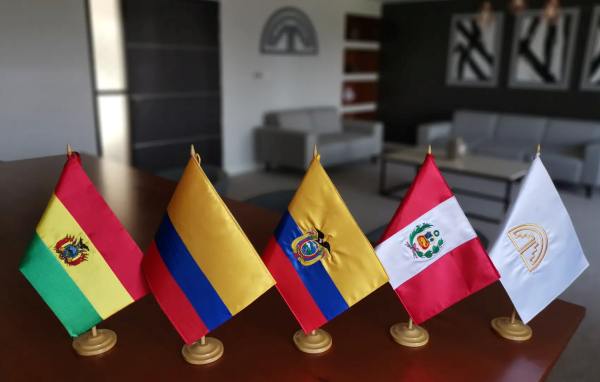
In October 2025, the Andean Community of Nations (CAN) formally approved China as an official observer, a move that reflects the bloc’s growing interest in deepening ties with Asia-Pacific economies.
As an observer, China participates in meetings with voice but without voting rights, allowing for dialogue on technical cooperation, trade facilitation, and infrastructure projects. This status expands the Community’s capacity for institutionalized engagement with global partners, providing a platform for collaboration without altering the rights or obligations of full member states.
Established in 1969 via the Cartagena Agreement, the CAN brings together Bolivia, Colombia, Ecuador, and Peru as full members, fostering economic, social, and technical cooperation, promoting a common market, and coordinating policies across trade, transport, investment, and regulatory frameworks.
The Community’s institutional structure includes a council of presidents, a council of ministers, a permanent commission, a regional parliament, and a regional court of justice, ensuring coordinated governance and legal oversight across its members.
The decision to include China as an observer aligns with CAN’s broader strategy to enhance its global projection and economic integration. China is a major destination for exports from CAN member countries, and this observer status provides an institutional channel for dialogue on trade, investment, and logistics. The partnership opens opportunities to coordinate on initiatives such as digital trade, infrastructure projects, and connectivity between the Pacific coast and Asian markets, strengthening the Community’s presence in global trade networks.
Beyond external relations, CAN continues to focus on intra-regional integration, aiming to remove trade barriers, harmonize regulations, and promote investment among its member states. Initiatives in sectors such as energy, transportation, and regulatory alignment have reinforced the region’s internal market and enhanced its competitiveness globally.
PPO Indacochea

PPO Indacochea is Bolivia’s leading full-service law firm, formed through the strategic merger of PPO Abogados and Indacochea & Asociados—two of the most prominent and respected legal institutions in the country. With the largest team of lawyers and the broadest geographic coverage in the market, we are uniquely positioned to deliver legal solutions that are innovative, multidisciplinary, and business-oriented.
Our approach is simple and effective: we provide solutions, not just opinions. We work closely with our clients to understand their businesses and deliver strategic advice tailored to their most complex challenges. We channel transformative foreign investment into Bolivia, advise on high-stakes disputes before local and international tribunals, and offer end-to-end legal services that bridge the gap between law and business.
With a team of 85 lawyers and over 180 professionals led by 14 partners, we operate across six offices in five cities nationwide. Our professionals include top-tier talent—most trained or specialized abroad—with a strong commitment to diversity, inclusion, and social responsibility.
At PPO Indacochea we redefine legal services to anticipate and exceed the demands of a fast-evolving business environment. We are proud to be consistently recognized by the most prestigious international legal directories, including Chambers and Partners, Legal 500, IFLR1000, Leaders League, Latin Lawyer, LACCA, and others, as Bolivia’s leading law firm. PPO Indacochea: Where law meets strategy, and local depth meets global vision.
